Your AI has the data. What might be missing is human context.

How continuously refreshed human context can help enterprises get more from the AI they already use.
Companies are investing heavily in AI with the expectation that it will do more than make work faster. They want it to help people make better decisions, improve customer experiences, and ultimately drive growth. So far, the results are uneven. Deloitte’s 2026 State of AI in the Enterprise found that 66% of organizations report productivity or efficiency gains from AI and 53% report improvements in insights and decision-making. But only 20% say AI is already increasing revenue, even though 74% hope it will in the future.
74% hope AI will grow revenue. Only 20% say it already is.
-Deloitte 2026 State of AI in the Enterprise
That value gap has many causes. But one may be hiding in the inputs. AI can synthesize enormous amounts of behavioral, transactional, and business data. What that data does not always provide is the human context that helps explain what the signals mean.
Consider a sales agent working inside an enterprise CRM. It can synthesize deal stage, product usage, website activity, email engagement, support history, past interactions, and changes in the buying committee. It can identify patterns across those signals and surface a recommended next step to the salesperson.
Imagine that an opportunity has stalled. The buyer has returned to the pricing page several times and opened recent emails, but has not moved forward. Based on those signals, the agent might recommend another follow-up or a commercial incentive.
Now add another source of context. Recent conversations with enterprise buyers in the same segment show that implementation complexity is becoming a recurring barrier. Buyers see the value of the product, but they are increasingly concerned about whether they have the internal resources to deploy it successfully.
That context changes the interpretation. Instead of leading with a discount, the agent could surface the emerging implementation concern and suggest that the salesperson discuss rollout support, services, or resourcing in the next conversation.
The behavioral and CRM signals did not change. What changed was the context available to interpret them.
What the data alone cannot explain
Companies have spent years building systems that capture customer behavior. CRM systems record relationships and opportunities. Analytics platforms reveal what people use and where they disengage. Service systems capture cases and issues. Transaction systems show what people buy.
These are essential inputs for AI. But they often show what happened better than they explain what drove it.
- Why did a prospect hesitate?
- What is preventing a customer from adopting a feature?
- What concern keeps surfacing during evaluation?
Those answers come from people. They reveal goals, priorities, motivations, expectations, constraints, and circumstances that may not show up in behavioral data. That is human context.
AI changes the role that context can play. Human context captured in reports, repositories, and conversations can become part of the intelligence enterprise systems use to interpret customer and business signals.
The same observable pattern can have very different explanations. Customers might try a new AI capability but not return to it because it is difficult to use. Or they may understand it perfectly well but lack confidence in the output, struggle to fit it into an existing workflow, or simply have a different need than the company assumed.
Context is already becoming part of the broader conversation about agentic AI. Gartner argues that AI agents need context to understand the relationships and rules within enterprise data, and that traditional data structures alone can lack the business meaning agents need to operate accurately. McKinsey similarly recommends that customer context “travel to every decision point” so agents can operate with a fuller picture rather than partial snapshots.
Much of that discussion focuses on making the information already inside the enterprise more useful to AI. But some of the context that can explain what customers and markets are doing does not live in CRM, analytics, or transaction systems. It comes directly from people.
Human context can become an enterprise input
Most companies are not starting from zero. Across sales, customer success, product, marketing, and insights teams, organizations are already collecting interviews, open-ended feedback, call transcripts, and other conversations that reveal what customers and markets need, expect, and care about. Historically, much of that understanding has lived in reports, repositories, or individual teams’ knowledge, which means someone still has to know it exists and apply it to the decision in front of them.
That changes how organizations can put the human context they already collect to work.
Patterns emerging across customer and market conversations can become available alongside CRM, product usage, service, and other business data, giving AI systems additional context as they interpret what is happening.
And the context does not have to come from that exact customer or account. It might come from similar buyers, people in the target market, or others whose experiences help explain what is changing across a segment or category.
The opportunity grows when organizations can also refresh that human context as new questions emerge.
AI can help keep human context current
Enterprise data rarely stands still. CRM activity changes as opportunities move. Product usage shifts as customers adopt new capabilities. Transactions, service interactions, and digital behavior continuously add new signals about what people are doing.
Human context has traditionally moved at a different pace.
Conversations with customers, prospects, and people in the market can help explain what those signals mean, but that understanding has usually been refreshed periodically. Talking to the right people, asking useful follow-up questions, analyzing what they say, and making that understanding available across the business takes time.
Enterprise data is continuously refreshed. Human context historically has not been.
Timeliness is becoming increasingly important as AI plays a larger role in interpreting information and informing decisions. Forrester argues that the context available to AI agents needs to be not only accurate and complete, but timely, because agents operate at digital speed. Its focus is real-time enterprise data, but the same underlying issue raises an important question for human context: how can organizations keep their understanding of people current as well?
AI-moderated conversations can ask open-ended questions, respond to what a person says, and probe when an answer raises something important. Combined with ongoing access to relevant people, that makes it possible to gather human context at a scale and cadence that would have been difficult to sustain through human moderation alone.
And those people do not have to be limited to existing customers. An enterprise could learn from prospective buyers, target-market participants, people in specific professional roles, people evaluating the category, or users of competing products.
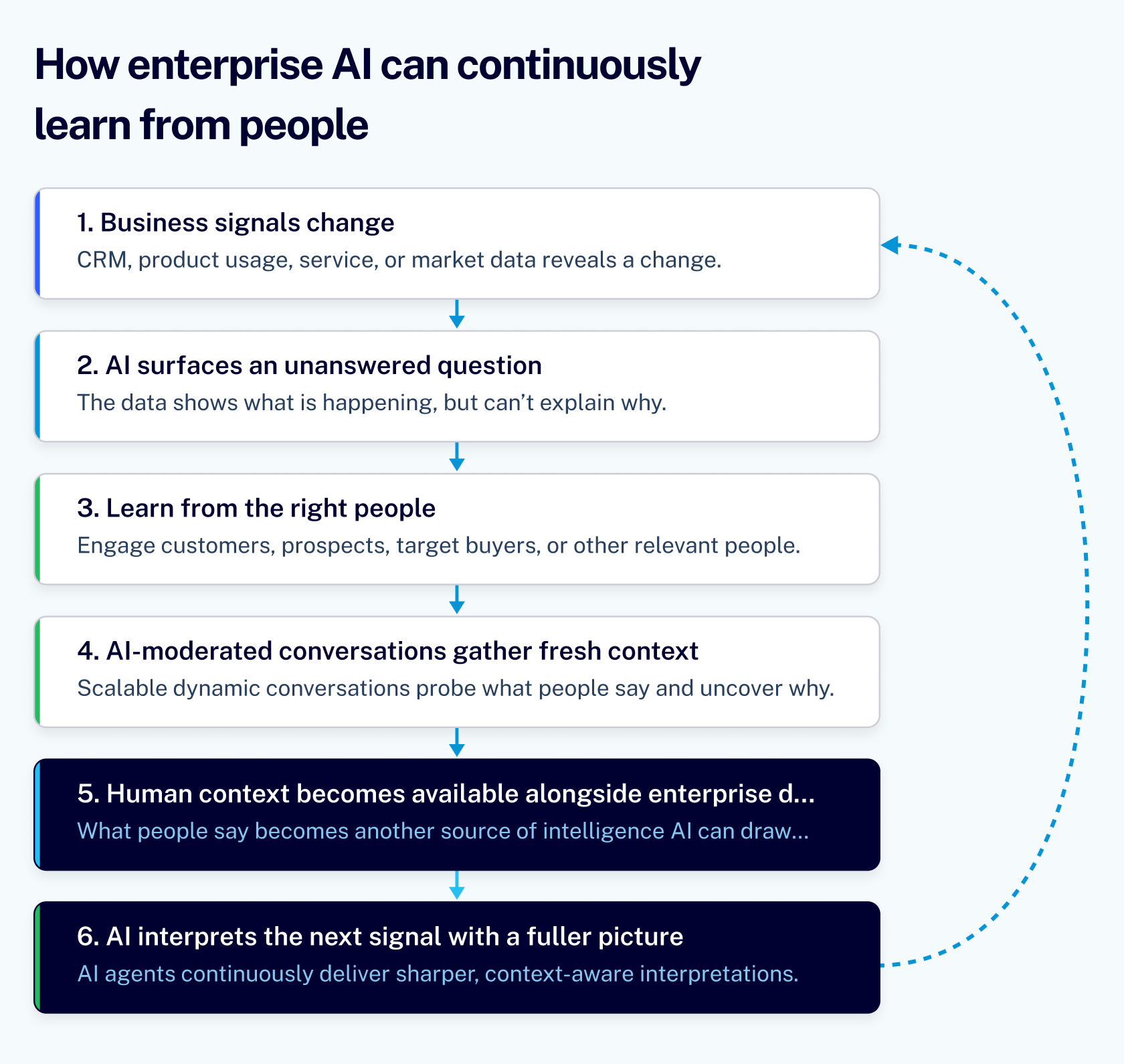
Consider a company that launches a new AI feature. Product analytics show strong activation, but repeat usage begins to fall after several weeks. The business can see the pattern, but its existing data does not explain what is driving it.
That pattern creates a question.
The company could quickly learn from users in the target audience. AI-moderated conversations could explore what has changed, ask follow-up questions, and probe where confidence begins to break down. Suppose those conversations reveal that users see value in the feature but do not trust it enough to rely on it consistently.
That fresh understanding can then become available alongside the usage data that raised the question in the first place. An AI system interpreting adoption trends now has more than a signal that repeat usage is falling. It has current human context about what may be driving the change and can surface that insight to the product team as it decides what to investigate or improve.
AI plays a role on both sides of that loop. It can help scale the conversations that create human context, and it can help put that context to work alongside the continuously changing data already flowing through the enterprise.
AI makes it possible to refresh human context far more frequently, bringing it closer to the pace of the behavioral and operational data enterprises already rely on. That gives organizations a more current understanding of customers, markets, and business conditions as they change.
Connecting what the business can observe with what people can explain
Companies are investing heavily in AI because they expect it to improve decisions, customer experiences, and ultimately business performance. The quality of the context available to AI shapes the interpretations, recommendations, and decisions it can help produce.
AI systems can continuously interpret CRM records, product usage, transactions, service activity, and other business signals. Human conversations add the needs, priorities, concerns, expectations, and circumstances that help explain what those signals mean.
AI now makes it possible to bring those sources together more continuously. It can help enterprises gather human context at greater scale and cadence, while making that context available to the systems already interpreting what is happening across the business.
Richer, more current human context can strengthen the decisions and actions that shape customer experience, growth, and business performance. That gives enterprises another way to increase the value they get from the AI investments they have already made.
When existing context is incomplete, a new signal can become a reason to learn more. AI can help the enterprise engage the relevant people, explore the question through AI-moderated conversations, and make that fresh context available to the systems interpreting what happens next.
This creates an ongoing learning capability for the enterprise. New questions can lead to new human context, giving AI a more current understanding of the customers and markets behind the data it is interpreting.
For companies trying to get more from their AI investments, the next source of value may come from connecting what the business can observe with what people can explain.